From Chania with Optimism: Highlights from SETN 2026
On the 11th of September, the 14th EETN Conference on Artificial Intelligence (SETN 2026) concluded successfully after three days of inspiring talks, interesting paper presentations and thought-provoking keynote speeches. The conference took place in the beautiful Chania, Crete and was organized by the Hellenic Artificial Intelligence Society (EETN) in collaboration with the Technical University of Crete and the Region of Crete.
As the head of research at Starttech Labs, I was given the privilege to participate and represent the wider Starttech Ventures entrepreneurial ecosystem including Epignosis and Yodeck, who actively supported the conference by being platinum sponsors.
The conference once again showed that Greece has a lot to offer in terms of research to the technology sector.
Ethics, interestingly enough, occupied a considerable part of the conference with many talks centered around it. A particularly interesting talk was from Prof. Marija Slavkovik with the title of “Good machines must be able to say no – towards normative governance for AI agents”. During her speech she talked about the importance of red lines in AI agents and expressed the counterintuitive idea of building agents able to disobey, and even break the rules in order to serve the common good. She illustrated this with a simple scenario. Imagine you’re at the airport and your bag is a few grams over the weight limit. A human employee might simply wave you through, knowingly bending company policy to offer better service. So why shouldn’t an AI agent be able to make the same reasonable exception?
A workshop I found particularly interesting was ‘Artificial Intelligence for natural sciences and engineering’. The workshop tried to take a multidisciplinary look at applications of artificial intelligence in scientific and engineering research pipelines. There were several natural sciences problem case studies presented as well as how they were modeled and approached by AI researchers. Interestingly enough, in most cases traditional ML approaches saved the day, with many of the algorithms used having already been with us a long time now. The variety of problems presented was mind-boggling with examples from energy, environment, nuclear up to bio-medicine and natural disasters.
LLMs and transformer-based AI was, as expected strongly represented in the conference, especially in the paper sessions with papers like ‘Beyond Parameter Count: Selecting Compact Language Models for Retrieval-Augmented Generation’ by (Alexandros Papafragkakis and Yannis Tzitzikas) ‘Can Small Models Have Big Impact? Efficient Greek Clinical Text De-identification via Synthetic Augmentation’ by (Vanessa Lislevand, Kostas Stamatis, Juli Bakagianni, Vasiliki Kougia, Kalliopi V. Dalakleidi and John Pavlopoulos) ‘Edge-Capable Open-Weight LLMs in Modern Greek NLP: A Reproducible Benchmark’ by (John Pavlopoulos and Juli Bakagianni) ‘Automated Encoding of Greek Legislation in JSON: Leveraging RAG and LLM for Legal Question Answering’ by (Nikoletta Fotopoulou and Ioannis Refanidis).
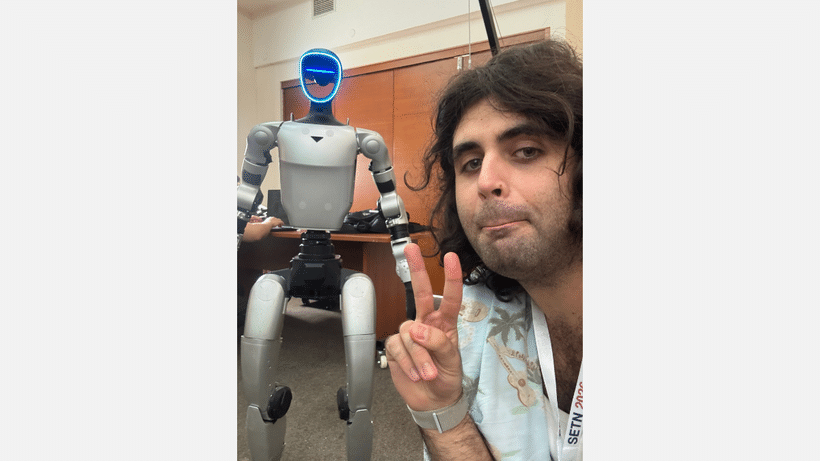
At the end of the first day there was an impressive robots exhibition facilitated by teams from ICS, FORTH and the Technical University of Crete. The exhibition was open to the wider public featuring various computer vision applications and really cool robots. The robots showcase included a variety of machines, from dog robots, to drones, to humanoids.
One dancing robot stole the show, to the delight of the participants
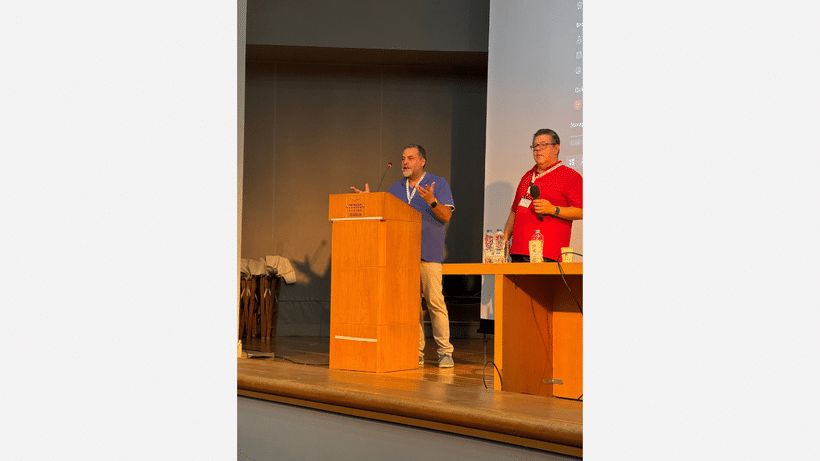
On the evening of the 2nd day during the industry talks, the Starttech ecosystem president Dimitris Tsingos presented his view on the future of AI in the industry, as well as in the wider society. Mr. Tsingos introduced the notion of the ancient Greek polis as a structure for contemporary companies where every employee works for the common good and where the place of AI agents is to be delegated all the menial work allowing humans to focus on the things that matter and create value.
SETN 2026 made one thing clear: Greece does not lack AI talent. Greek researchers, at home and abroad, are doing work that stands alongside the best in the world. The strong industry presence in Chania showed that companies are ready to put that work to use. The challenge now is to close the gap between the lab and the market, turning research into products, startups, and jobs here in Greece.
The future of AI will bring its share of risks, and conferences like SETN remind us to take them seriously. But I leave Chania optimistic. If we build machines that know when to say no, and people who know when to say yes to new ideas, AI can become one of the best tools we have ever had for improving our lives.