What Growth Reveals About Clarity, Ownership, and Culture
Growth rarely breaks a company in obvious ways. It doesn’t arrive with alarms or dramatic turning points. Instead, it quietly changes how people coordinate, how decisions are made, and how responsibility is experienced. What once worked effortlessly begins to feel heavier. Conversations take longer. Ownership feels less clear. Not because the culture has weakened, and not because people care less, but because growth reveals something subtle: the mechanisms that once created clarity were built on familiarity, and familiarity does not scale forever.
A moment of magic
There is a special feeling in the early days of a company where culture isn’t something written on a wall. It is a shared nervous system. When a team consists of twelve people sitting in a single room or a single digital chat, coordination happens naturally.
In this stage, everyone knows what everyone else is doing. You do not need a complex chart to know who is fixing the server because you can see the look of panic on the lead engineer’s face. You do not need a formal approval process for a marketing campaign because the founder is sitting two desks away. This is high speed, low friction, and deeply intuitive. It relies on personal relationships and the fact that everyone is basically breathing the same air. I call this the Identification Stage. You identify the problems because you are standing right next to them.
But as a company grows toward 50, 100, or 500 employees, this invisible way of working begins to glitch. We often misdiagnose these glitches. We think we hired the wrong people or that the “early spirit” is dying. In reality, the company has simply outgrown the laws of physics. To survive, a company must move from working based on “knowing each other” to working based on “owning the work.”
When You Can’t See Everything Anymore
The transition from a small team to a medium-sized company is rarely a clean break. It is a slow buildup of small frustrations. Think of a common situation in a growing software company. At fifteen people, everyone knows how the app works. If something breaks, someone yells out to ask who touched the code and the person responsible raises their hand.
But at seventy people, that broken piece of code might have been built by three people who have since moved to different departments. When it fails, the “Identification” model breaks down. Because no one feels like that specific piece of code belongs to them anymore, it becomes “No Man’s Land.”
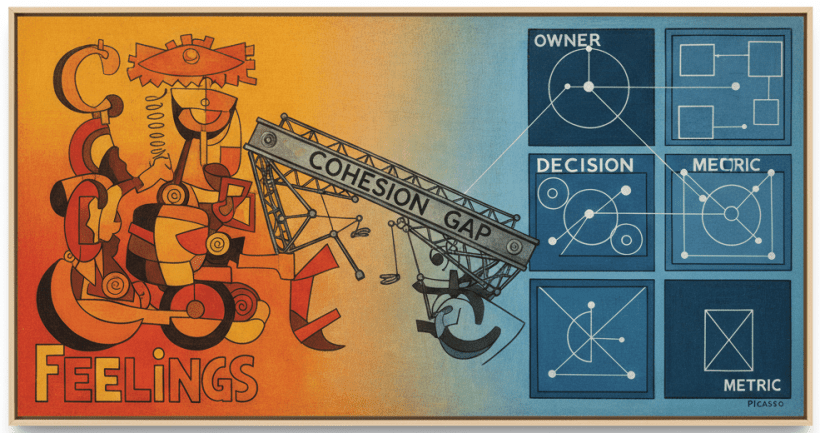
The result is not just a technical bug. It is a cultural one. People start pointing fingers. Or, even worse, everyone sees the problem but assumes someone else is fixing it. This is the Cohesion Gap. It is the space between how complex the work has become and our ability to keep track of it just by “feeling” it. As the work gets harder, our ability to keep it all in our heads stays the same. Eventually, we hit a wall.
“We Need Stronger Culture”
Many founders resist giving people specific titles or territories because they fear “red tape.” They want to keep things “flat” to stay fast. However, looking closely at flat organizations shows a strange result. A lack of clear structure actually slows things down.
In a flat organization of 100 people, every decision becomes a group project. Without clear ownership, the default state is “The Committee.” Because it is unclear who has the final say, employees spend more than half their time in meetings just trying to get everyone on the same page instead of actually doing the work.
Structure is not the enemy of speed. It is the reason speed is possible. When we define who owns a specific area, we are not building walls to keep people out. We are drawing lines so people know where they can run. These lines allow an individual to move fast in their own space without having to ask the “tribe” for permission every time they want to turn a corner.
A Concrete Shift
To fix this, leadership must change how they think about ownership. In a tiny startup, ownership is a feeling. It’s the idea that “I care about this company.” In a growing company, ownership has to be a deal. It’s the idea that “I am the person responsible for this specific result.”
Think of your company as a map. In the early days, the map is just one big field. As you grow, that field needs to be divided into lots. If you do not clearly mark the fences, you create “Grey Zones.” These are areas where two people think they are the boss, which leads to fighting, or where no one thinks they are the boss, which leads to things falling apart.
The Design Team
Let’s look at a real example of this. Imagine a company growing from 40 to 120 people. At first, the design team worked as a group. Any designer could work on any project. This felt fair and flexible. But as the product grew, things got messy. Designers were making different choices for the same app because they didn’t have the full story on every part of the business.
The company decided to change. They gave each designer a “plot of land.” One person owned the “Sign-Up” experience, another owned the “Shopping Cart,” and another owned the “Settings.”
By drawing these lines, a new deal was made. The person owning the “Sign-Up” page no longer had to ask the whole company for permission to change a button. They owned that space. The result was that work got done faster because the circles of people involved were smaller. More importantly, the designers felt more proud because they truly “owned” their specific part of the product.
The four Simple Rules of Ownership
To move past the “startup phase” and grow successfully, every project or task needs to follow four simple rules. If any of these are missing, ownership will fail.
First, there must be a Single Point of Contact. This is the “Who.” It cannot be a group or a whole department. It must be one person. Who is the person who feels the weight of this task? If two people own it, no one owns it. This isn’t about blaming someone when things go wrong; it’s about knowing who to go to for an answer.
Second, they must have the Power to Decide. This is the “Authority.” Does the owner have the right to say “no,” even to the boss, regarding their specific area? If you give someone responsibility but no power, they aren’t an owner. They are just a babysitter. True ownership means having the right to make a call and even the right to make a mistake.
Third, they must have the Tools. This is the “Means.” Does the owner have the money, the software, and the help they need? Asking someone to be responsible for a goal without giving them the tools to reach it is the fastest way to make your best people quit.
Fourth, they must have a Way to See Results. This is the “Signal.” How does the owner know if they are doing a good job? Without clear facts and numbers, ownership is just a word. An owner needs to be able to see their own “scoreboard” in real time.
Why Clear Lines Make People Happier
We often think of “structure” and “rules” as cold or boring. In reality, clear ownership is the best way to make people feel safe at work. Most stress at work comes from not knowing what is expected of you.
When an employee doesn’t know where their job ends and someone else’s begins, they spend their day worrying. They worry about stepping on someone’s toes or getting in trouble for something they didn’t know they were supposed to do. By defining ownership, you give people a “Home Base.” They know exactly what they are responsible for, exactly where they are free to try new things, and exactly who to ask for help. This removes the “office politics” and lets people focus on the work they love.
Letting Go
The hardest part of this change isn’t the paperwork. It is the emotional shift for the leaders. For a founder, moving from “knowing everything” to “using a structure” feels like losing control. You no longer know every tiny detail of what is happening in the office.
However, growth proves that you cannot be everywhere at once. You can’t scale your own eyes and ears, but you can scale your values by setting up a good system. When you build a system of clear ownership, you aren’t giving up. You are trusting your team to lead. The goal of a leader is to move from being the person who “fixes everything” to the person who “builds the system that fixes everything.” You stop plugging the holes in the boat and start designing a better ship.
A New Way to Think About “We”
The phrase “We are a family” is great for a team of ten. But for a team of two hundred, “We are a professional team with clear roles” is actually much kinder. Growing up doesn’t have to mean losing your passion. It just means losing the confusion.
By being clear about who does what, companies can keep the excitement of their early days while building the strength they need to become huge. The next time you feel like your company is getting “messy,” don’t look for someone to blame. Look for a line that hasn’t been drawn yet. Being clear isn’t just a management trick. It is the best way to show your team that you respect their time and their talent.
In the end, moving from “everyone doing everything” to “everyone owning something” is how a company truly matures. It is the moment where a “good vibe” turns into a “great mission.” By drawing the lines clearly, you allow everyone to finally know exactly where they stand and exactly how they can help the company win.