Beyond Prompting:Drompting as Human–AI Collaboration through Ichnography
A Foundational Position Paper
Abstract
Large Language Models have transformed human–AI interaction by making natural language the primary interface between people and intelligent systems. While this paradigm has dramatically lowered the barrier to communication, it implicitly assumes that meaningful thought is already expressible in language. Human cognition, however, often begins long before words emerge. Ideas frequently develop through tentative sketches, gestures, symbols, arrows, spatial arrangements, incomplete representations, and evolving visual traces that support exploration rather than explanation.
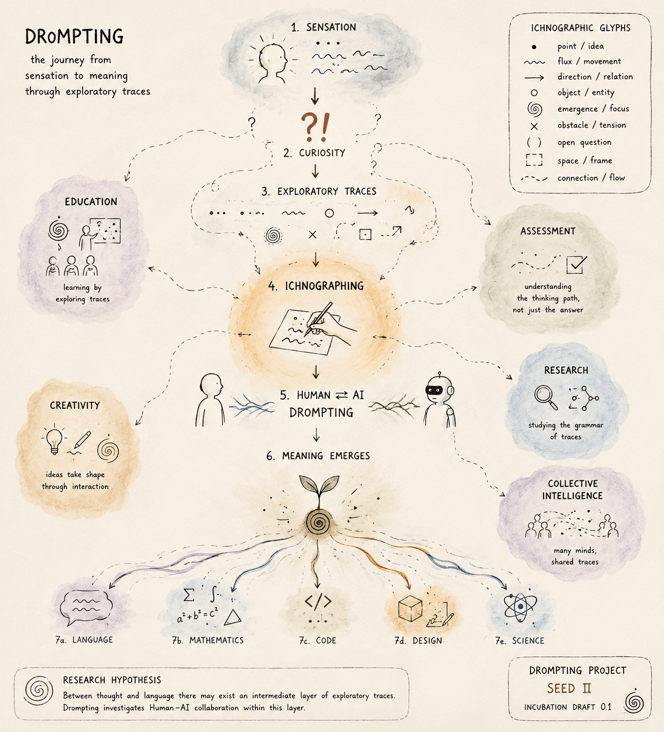
This paper proposes that these exploratory traces constitute an intermediate representational layer between thought and language. We call these representations ichnographs and the collaborative process through which humans and AI construct, interpret, and refine them drompting. Rather than replacing prompting, drompting extends it by enabling interaction during the formative stages of reasoning, before ideas crystallize into natural language or formal symbolic systems.
We present drompting as a research hypothesis rather than a completed methodology. We argue that this perspective opens new directions for education, assessment, creativity, and collective intelligence while raising fundamental research questions concerning the possible grammar of exploratory representations. Our goal is not to introduce another interaction technique but to establish a conceptual framework for investigating human–AI collaboration at the level where ideas first begin to take form.
1. The Language Bottleneck
Recent advances in artificial intelligence have made conversation the dominant paradigm of human–computer interaction. Prompting has become the universal mechanism through which users communicate intentions, questions, and goals to AI systems.
This success, however, conceals an implicit assumption: that human thought already exists in linguistic form.
In practice, this is often not the case.
Scientists draw diagrams before writing proofs. Designers sketch before producing specifications. Children scribble before writing. Mathematicians fill pages with arrows, circles, crossed-out ideas, and partial constructions before arriving at formal reasoning. Teachers frequently understand a student’s thinking not from the final answer but from the intermediate marks left during problem solving.
Language is therefore not always the beginning of reasoning. It is often one of its outcomes.
If this observation is correct, then current prompting interfaces interact primarily with the end of a cognitive process rather than with its emergence.
2. Before Language
Between perception and language lies a stage that is difficult to describe but immediately recognizable in practice.
It consists of exploratory traces:
· tentative sketches,
· spatial arrangements,
· incomplete diagrams,
· arrows,
· symbols,
· erased attempts,
· visual groupings,
· handwritten notes,
· emerging patterns.
These traces are not intended to communicate completed knowledge.
Their purpose is to support thinking itself.
Unlike formal diagrams, they tolerate ambiguity. Unlike natural language, they need not obey grammatical rules. Unlike finished illustrations, they remain deliberately incomplete, inviting modification and reinterpretation.
Their value lies precisely in their openness.
Rather than documenting conclusions, they preserve the process through which understanding gradually emerges.
3. Ichnography
We propose the term ichnography to describe the intentional externalization of emerging thought through exploratory traces.
The term derives from the Greek word ἴχνος (trace, footprint), emphasizing that these representations are not finished descriptions but cognitive traces left during exploration.
This distinction is important.
Sketching produces drawings.
Ichnographing externalizes thought while it is still forming.
An ichnograph should therefore not be evaluated according to artistic quality or formal correctness. Its purpose is neither explanation nor documentation. Instead, it serves as an evolving workspace where ideas can appear, interact, disappear, and reorganize.
This perspective suggests that ichnographs are not merely visual artifacts but cognitive artifacts.
A central research question naturally follows.
Do ichnographs possess an emergent grammar rather than a predefined visual vocabulary?
Rather than assuming a fixed symbolic language, we hypothesize that recurring organizational patterns may emerge through repeated human exploration and collaborative interaction with AI.
4. Drompting
If prompting enables communication through language, drompting extends communication into the pre-linguistic stages of reasoning.
We define drompting as follows.
Definition.
Drompting is the collaborative process through which humans and AI construct, interpret, and refine exploratory traces before these traces crystallize into natural language or formal symbolic representations.
In this view, AI no longer acts merely as a conversational assistant responding to completed prompts.
Instead, it becomes a participant in the gradual formation of ideas.
The objective is not to generate immediate answers but to support exploration, reveal possible structures, expose inconsistencies, suggest alternative organizations, and encourage the evolution of understanding.
Prompting begins with language.
Drompting begins with traces.
5. Research Hypothesis
The central hypothesis of this position paper is intentionally simple.
Research Hypothesis
Between thought and language there may exist an intermediate representational layer composed of exploratory traces.
We call these representations ichnographs.
If such a layer exists, several consequences follow.
First, interaction between humans and AI may begin before complete linguistic formulations become available.
Second, educational assessment may focus not only on final answers but also on the developmental trajectories through which those answers emerge.
Third, visual representations may function as dynamic thinking environments rather than static explanatory diagrams.
Finally, AI systems may eventually learn to recognize, organize, and collaborate through exploratory traces without requiring immediate translation into language.
These propositions remain hypotheses.
Their validity depends on future theoretical analysis and empirical investigation.
6. Implications
Education
Learning is often evaluated through completed solutions.
Drompting suggests shifting attention toward the evolution of understanding itself.
Ichnographs may enable teachers to observe conceptual development, misconceptions, and moments of insight that remain invisible in final answers.
Assessment
Traditional assessment measures outcomes.
Drompting introduces the possibility of assessing reasoning trajectories.
Rather than asking only whether a learner reached the correct conclusion, assessment may also examine how understanding gradually developed.
Creativity
Creative work rarely begins with polished language.
Ideas typically evolve through incomplete representations that invite continual revision.
Human–AI collaboration at this stage may support ideation without prematurely constraining exploration.
Collective Intelligence
Groups frequently develop shared understanding through whiteboards, diagrams, sticky notes, and collaborative sketches.
Drompting suggests that AI could participate within these evolving representational spaces rather than entering only after discussions have already been translated into language.
7. Open Research Questions
This paper intentionally concludes with questions rather than answers.
· Do exploratory traces exhibit recurring structural principles that constitute an emergent grammar?
· Can AI systems learn to interpret and generate ichnographs collaboratively without predefined symbolic conventions?
· How should ichnographic interaction be represented computationally?
· Which educational benefits emerge when learners construct ichnographs before writing textual explanations?
· Can assessment based on reasoning trajectories improve our understanding of conceptual development?
· What forms of collective intelligence become possible when humans and AI share evolving exploratory representations?
These questions define a research agenda rather than a finished theory.
Conclusion
Prompting has established natural language as the dominant interface between humans and artificial intelligence.
This paper proposes that language may not be the earliest point at which meaningful collaboration becomes possible.
By introducing the concepts of ichnography and drompting, we hypothesize the existence of an intermediate representational layer where ideas first emerge as exploratory traces before becoming language, mathematics, code, or design.
Whether this hypothesis proves correct remains an empirical question.
Its significance lies less in offering immediate answers than in opening a new direction for investigating human cognition, learning, creativity, and human–AI collaboration.
If prompting transformed how we communicate with AI, drompting invites us to explore how humans and AI might learn to think together before words appear.