Craftsmanship and Technique
If you observe people at work long enough, you begin to notice a subtle but important difference in how they approach what they do. At first glance the difference is easy to miss. Many professionals appear equally capable. They know the tools of their trade, they solve problems, and they deliver results. Yet over time a distinction emerges that has less to do with skill itself and more to do with the relationship a person develops with their work.
This distinction is often described through two familiar figures: the technician and the craftsman.
In everyday language these words are sometimes used interchangeably. Both refer to people who possess technical ability. Both suggest competence and experience. But if we look more closely, they describe two different orientations toward work.
A technician is someone who has learned how to perform tasks correctly and reliably. Their value lies in execution. They understand procedures, tools, and established methods. When a problem appears, they look for the appropriate technique to apply. When a task needs to be completed, they know how to do it efficiently and with minimal friction.
Technicians are essential in every field. Modern organizations depend on people who can apply knowledge consistently and turn plans into functioning outcomes. Without this reliability, even the best ideas would remain theoretical.
The craftsman, however, approaches work from a slightly different place.
A craftsman is not defined only by the ability to execute tasks. Instead, they carry a deeper sense of responsibility for the quality and integrity of what they produce. The question is not simply whether something works, but whether it has been made well.
This difference may sound subtle, yet it changes the entire relationship between the person and the work.

Where the technician focuses on applying the right method, the craftsman focuses on understanding the nature of the problem itself. Where the technician seeks the correct procedure, the craftsman seeks the most thoughtful solution. Over time this leads to a deeper awareness of the system surrounding the task.
The distinction becomes especially visible when something unexpected occurs.
When familiar processes no longer apply, technicians often search for the next appropriate tool or documented method. Craftsmen, by contrast, step back and ask a more fundamental question. They try to understand what is really happening beneath the surface and whether the situation requires a different approach altogether.
In this sense craftsmanship is less about mastery of tools and more about ownership of outcomes.
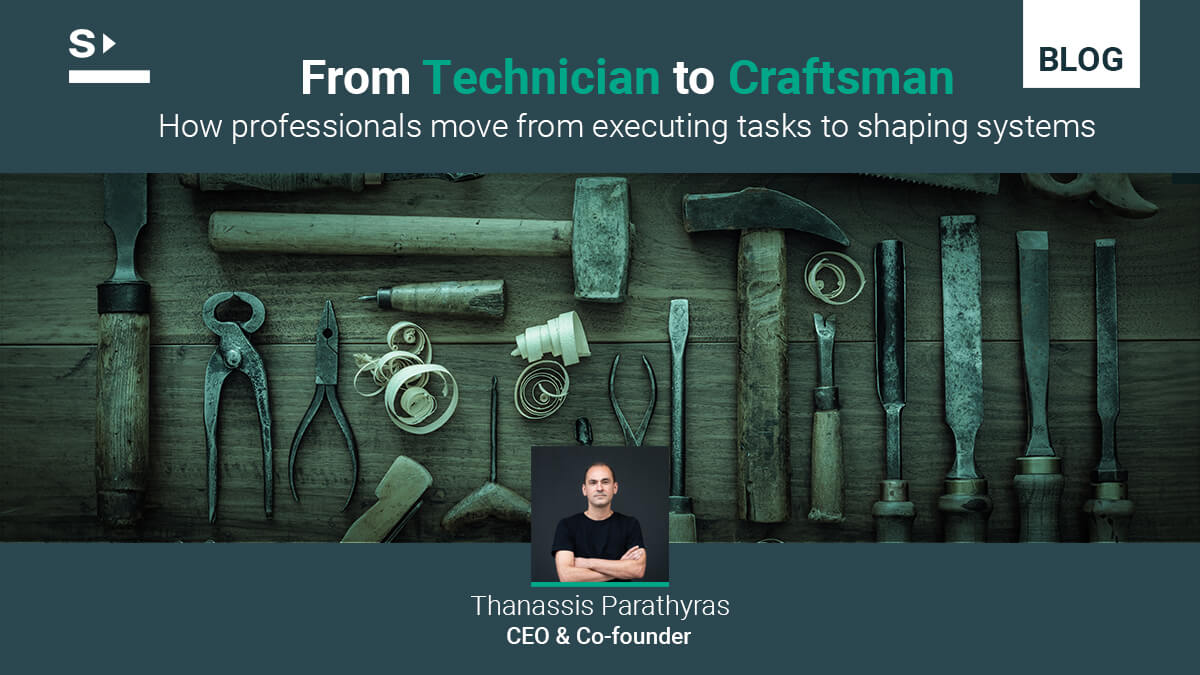
Historically, craftsmanship was easier to recognize because it was tied to physical trades. A carpenter shaping wood, a watchmaker assembling delicate mechanisms, or a mechanic rebuilding an engine all demonstrated visible care in how things were made. The quality of the work spoke for itself.
In modern knowledge work, and particularly in technology, the difference is harder to see. Software systems are intangible. Infrastructure runs in distant data centers. Tools automate large parts of the work that once required deep manual effort.
Because of this, the line between technician and craftsman often becomes blurred.
Powerful frameworks and automated platforms allow many tasks to be completed without requiring full understanding of the systems underneath. A developer can assemble applications using existing components. An engineer can deploy infrastructure through automation pipelines. A problem can be solved quickly without necessarily understanding the deeper structure that made it possible.
None of this is inherently negative. In fact, abstraction and automation are signs of progress. They allow teams to build faster and solve problems that would otherwise remain out of reach.
Yet they also make craftsmanship more difficult to recognize and, in some cases, easier to overlook.
When the focus shifts entirely toward speed and output, work can gradually become a sequence of technical steps rather than a thoughtful process of building something that will last. Systems may function today while quietly accumulating complexity and fragility beneath the surface.
This is where craftsmanship becomes particularly valuable.
A craftsman in a modern engineering environment does not necessarily write more code or deploy more systems than others. Instead, they think carefully about how things fit together. They pay attention to structure, maintainability, and long term consequences. They consider not only whether a system works, but whether the people who inherit it tomorrow will be able to understand and evolve it.
In this way craftsmanship introduces a long horizon into everyday work.
Technicians often optimize for completion. Craftsmen tend to optimize for coherence. The first asks whether the task has been finished. The second asks whether the result makes sense within the larger system.
Organizations frequently struggle to recognize this difference because both roles can appear equally productive in the short term. A functioning system looks the same regardless of how it was produced. The true distinction often appears only later, when the system must evolve, scale, or recover from failure.
At that point the invisible decisions made during its creation begin to reveal themselves.
This observation does not suggest that technicians and craftsmen belong to different categories of people. In reality the two often represent stages in the evolution of professional thinking.
Most people begin their careers as technicians. They learn tools, techniques, and best practices. They follow established patterns and gain confidence through repetition. This stage is essential. Without it there is no foundation on which deeper understanding can grow.
Craftsmanship begins when someone starts to move beyond the execution of tasks and develops a sense of responsibility for the system as a whole. They begin to ask why things are built in certain ways, what tradeoffs are hidden in technical decisions, and how present actions shape future outcomes.
Over time their work becomes less about following instructions and more about shaping the environment in which those instructions exist.
In many ways this transition mirrors the broader evolution of engineering itself. Early in any field, progress depends on mastering techniques. As the field matures, the challenge becomes managing complexity and making thoughtful decisions about systems that no single person can fully see.
The difference between a technician and a craftsman reflects this shift.
One ensures that work gets done. The other ensures that what gets built remains meaningful and resilient over time.
In an era where tools grow increasingly powerful and automation continues to accelerate, the role of craftsmanship may become even more important. When technology makes it easier than ever to produce results, the true measure of expertise may lie not in how quickly something can be created, but in how thoughtfully it has been built.
And perhaps the most interesting realization is that craftsmanship does not begin with a new tool or a different role. It begins with a change in how a person sees their responsibility toward the work itself.
The technician asks how to complete the task.
The craftsman asks how to make it worthy of existing.