Greece’s Next Tech Hubs Will Not Ask for Permission
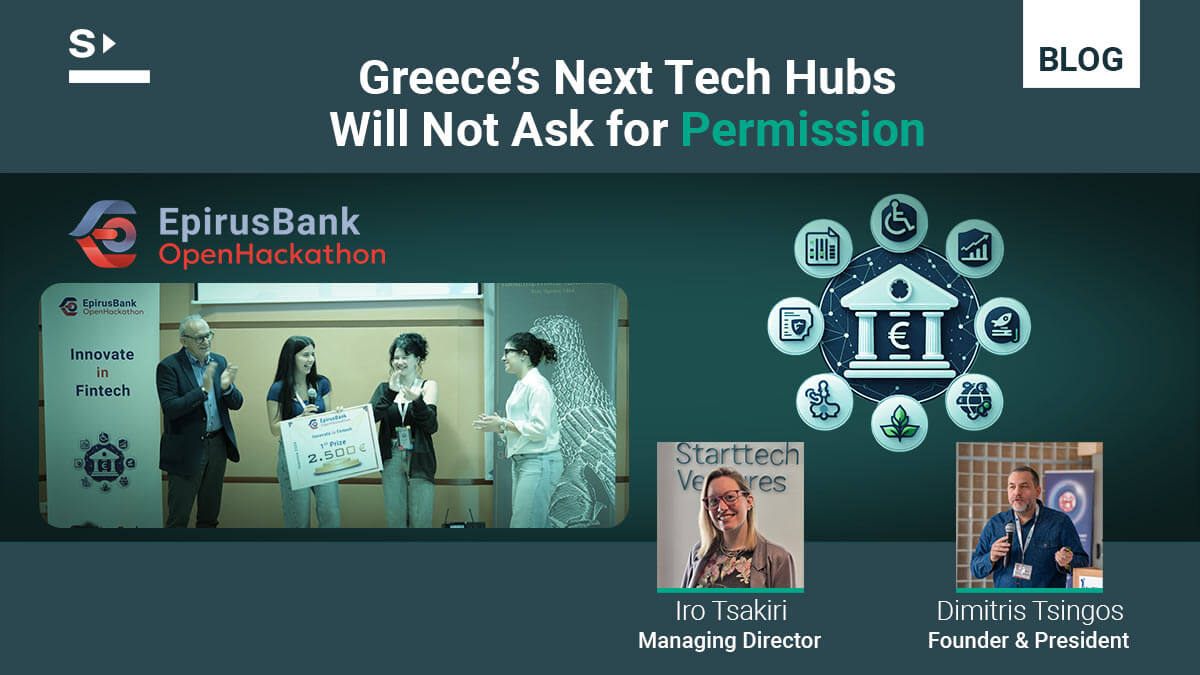
What we saw last weekend of May, at Epirus Hackathon, in Ioannina deserves attention.
Not because it was another successful hackathon.
Not because prizes were awarded.
Not because people stayed up late, wrote code, presented ideas and took photos.
All these things matter, of course. But they are not the real point.
The real point is that there is serious talent building real things outside the Athens bubble.
At the EpirusBank OpenHackathon, organized by Open Conf and Epirus Cooperative Bank at the University of Ioannina, the most impressive part was not only the technical execution. It was the quality of thinking.
The problem framing.
The go-to-market instinct.
The willingness to pivot during the build.
The understanding that a product is not just code.
The ability to ship something under pressure.
Some of the teams did not feel like “student projects”. They felt like early signals of products.
This is important.
For many years, the Greek tech ecosystem has been growing. We now have better founders, better teams, better investors, more international ambition and more examples of companies that can start in Greece and compete globally.
But there is still one question we need to answer honestly:
Will Greek tech remain mostly an Athens story?
Our answer is no. Or, at least, it should be no.
Athens is, and will remain, the largest hub. That is normal. Density matters. Access to capital matters. Networks matter. Customers, talent, investors, events — all these things are easier when they are concentrated.
But Athens alone is not enough.
If Greece wants to build a truly strong technology economy, the next phase has to include more cities. Thessaloniki. Patras. Heraklion. Nicosia. Ioannina. And others.
Not as satellites.
Not as “regional exceptions”.
But as real hubs with their own identity, their own communities and their own momentum.
Ioannina has many of the ingredients.
A strong university.
A beautiful city.
A very good quality of life.
A serious talent pool.
A local community that seems willing to build.
And this last point may be the most important one.
Ecosystems are not built by announcements. They are not built by slogans. They are not built because someone decided that a city “should become a hub”.
They are built when people start doing the work.
When organizers create the events.
When students and young professionals show up.
When companies open real problems to the community.
When banks and institutions stop being passive sponsors and become active participants.
When experienced people give time, feedback and access.
When teams ship.
This is what happened in Ioannina.
Of course, one hackathon does not create an ecosystem. We should be very clear about that. A strong ecosystem needs repetition. It needs continuity. It needs capital, customers, mentors, founders, universities, companies and institutions working together over time.
But a hackathon can create a spark.
And sparks matter.
Especially outside Athens, where people often wait for permission. They wait for the “right” conditions. They wait for someone else to start. They wait for proof that their city can matter.
But this is not how entrepreneurial ecosystems are built.
They are built by people who start before everything is ready.
This is also why open and collaborative culture matters so much.
If every city, every team, every company and every institution tries to build in isolation, we will lose a lot of time. And Greece does not have unlimited time. We need to connect talent faster. Share knowledge faster. Build trust faster. Help first-time founders faster.
The Greek ecosystem is still small enough for collaboration to make a real difference.
We should use that.
We need more bridges between cities. More founders helping founders. More companies opening up to communities. More universities connected to the market. More local initiatives that are not waiting for central approval.
And in the GenAI era, this open mindset becomes even more important.
Open software and open platforms — open source, to be precise — are becoming strategically important again. Not only for innovation, but also for trust, transparency, talent development and digital sovereignty.
This matters a lot for Greece.
We are not going to win by copying Silicon Valley. We are not going to win by pretending we have unlimited capital. We are not going to win through closed networks and small circles.
We can win by being fast.
By being focused.
By being collaborative.
By being capital-efficient.
By being open.
These are strengths we can actually build on.
At Starttech Ventures, and in the broader ecosystem around us, we have always believed in community. Not as a PR activity. As infrastructure.
Communities create trust.
Trust creates collaboration.
Collaboration creates companies.
And companies create the next generation of founders.
That is why events like the EpirusBank OpenHackathon matter.
The winners deserve congratulations. So do all the participants. But the larger point is not only who won. The larger point is that Ioannina showed real signals of ecosystem potential.
The question now is whether these signals will continue.
Will there be more events?
More teams?
More support from local institutions?
More connection with experienced founders and investors?
More ambition to build for international markets from day one?
This is the work.
The future of Greek tech will not be written only in Athens.
It will be written wherever talented people decide to stop waiting and start building.
It will be written in cities that combine universities, quality of life, ambition and community.
It will be written by people who understand that shipping is the only metric that really matters.
Ioannina may very well become one of these places.
What we saw last weekend was not proof that the ecosystem is already there.
But it was proof that something is happening.
And that is how every serious ecosystem starts.