On preparation, action, and the ideas still sitting on the shelf
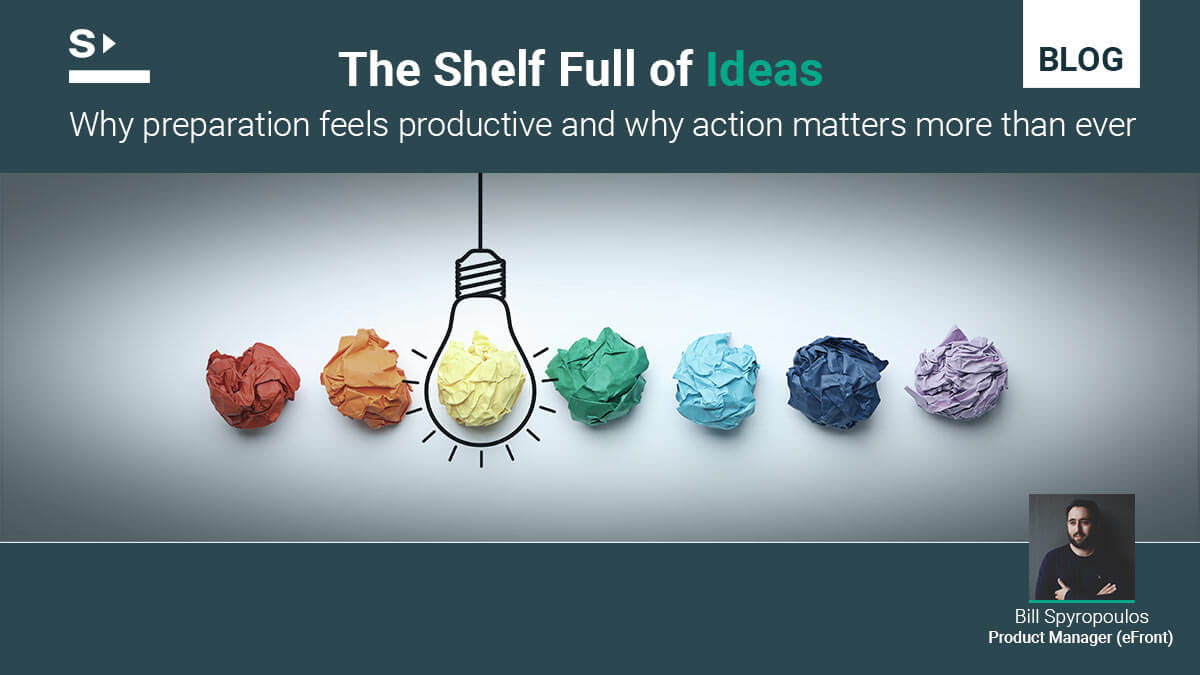
I have ideas on a shelf. More than a few. Some of them were probably worth pursuing. They are still there.
For a long time I told myself this was responsible. I was learning, preparing, building context. I read books about starting businesses, about cash flow, about product-market fit, about what founders get wrong. Reading is valuable — some of it genuinely changed how I think. But somewhere along the way the reading stopped being preparation and started being a substitute for action.
The books showed me what could go wrong in enough detail that starting felt irresponsible. That is not what they intended. But that is what happened.
The preparation trap
There is a particular pattern I recognise in myself and in a lot of people around the startup ecosystem: mistaking preparation for progress. Another book, another framework, another conversation about the idea. It has the texture of work. It feels productive. But it is a way of staying comfortable while telling yourself you are moving forward.
The real cost is not the lost revenue or the missed market window. It is what it does to your relationship with your own judgment. Every time you understand a
problem deeply and still do not act, you train yourself to believe that understanding is enough. It is not.
Good books — and there are good ones — will tell you this themselves. The frameworks they give you are meant to be tested against reality, not used to model reality from a distance. The insight only lands when you are in it.
What AI changes about the first step
The distance between an idea and something real used to be measured in months. You needed a developer, a spec, a budget, a co-founder, a plan. By the time you had a prototype, you had invested enough that it was genuinely hard to be honest about whether it was working. The cost of starting made starting feel like a commitment that required certainty first.
That cost has collapsed. A working prototype is now hours away, not months. You can put something in front of a real person before the hesitation has time to build into a full argument against starting. The window between idea and feedback is short enough that preparation stops being a reasonable excuse to wait.
This is not about skipping the thinking. The judgment, the problem understanding, the user insight, none of that becomes less important. What changes is the threshold for finding out whether your thinking is right. You no longer need to have it figured out before you start. You just need enough curiosity to take the first step and see what comes back.
The shelf problem
Most ideas that stay on the shelf are not bad ideas. They are ideas that never got tested because the cost of testing felt disproportionate to the uncertainty. Reading gave the uncertainty a name and a shape, which made it feel even larger than it was.
When the cost of a first version collapses, the threshold for acting on an idea changes. Not the quality of the idea but the willingness to find out. That is a different thing, and it matters.
The hard parts of building something do not go away. Distribution, timing, iteration, the relentless work of making something people actually want. To be honest, I believe AI does not solve any of that. But the first gate, the one that used to require a business plan and six months of preparation, is now just a few hours and an honest question: is there something here?
I should be honest here: I have not acted on any of my own ideas yet. They are still on the shelf. This article is partly a public note to myself, a point in time I can come back to and check whether I finally did something about it, or whether I found new and more sophisticated ways to prepare.
Writing it down felt like the least I could do.